
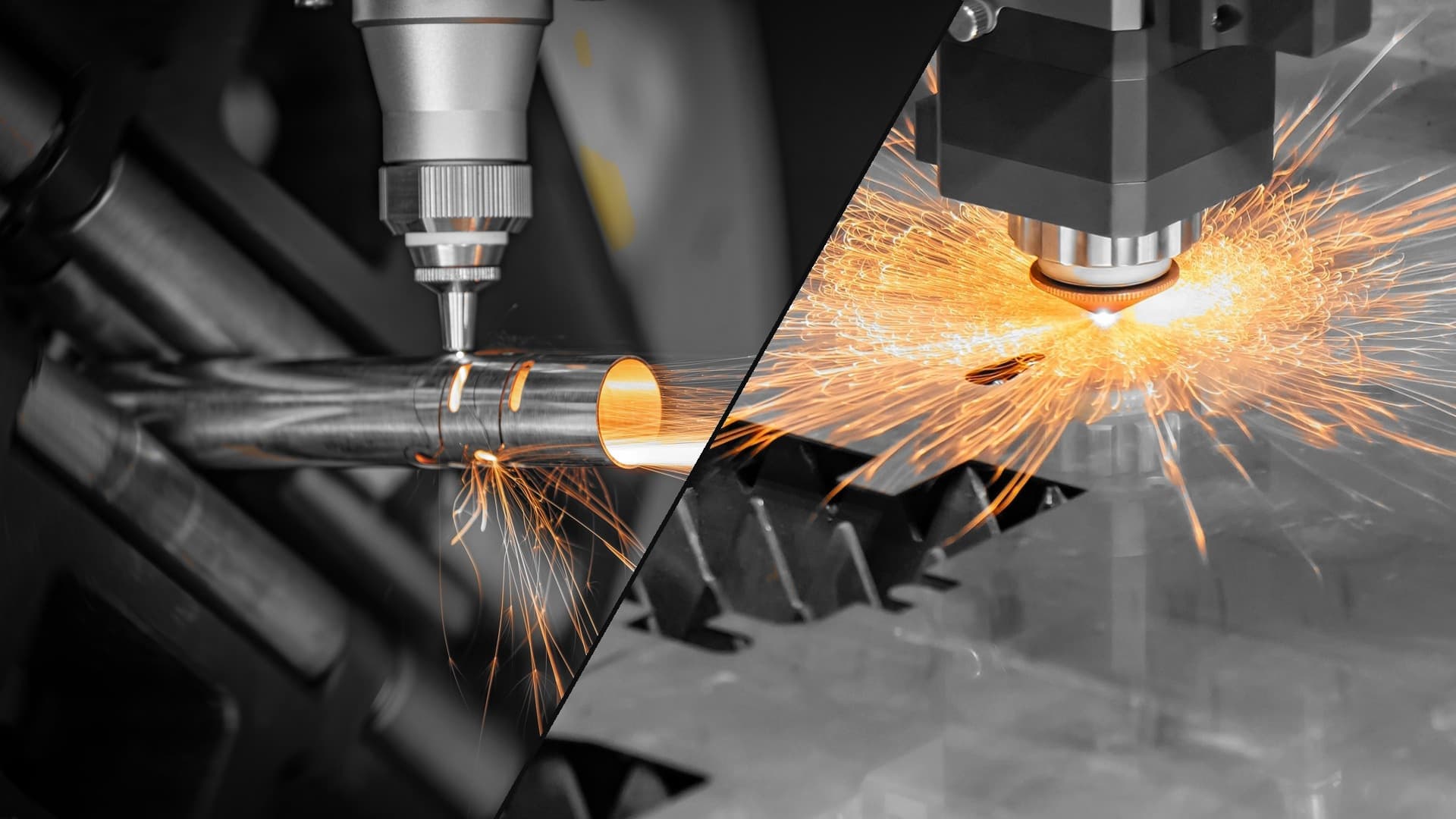
Precision down to 0.1 mm
A laser beam focused to a diameter of less than 0.1 mm enables the cutting of complex geometries and fine details that conventional methods cannot achieve.
Sheet/plate laser cutter
We cut steel, aluminium and stainless steel. Steel up to 15 mm, aluminium up to 3 mm and stainless steel up to 6 mm thick. Maximum sheet size is 3000×1500 mm.
Tube laser
Cutting of tubes up to 6 m in length and from 20 mm to 220 mm in diameter. A wide range of tube profiles, from standard round (O) to I, H, U and L.
Minimal waste
A narrow kerf of only 1–2 mm means less wasted material and lower raw material costs, especially with expensive metals.
How does laser cutting work?
Laser cutting uses a concentrated, high-energy beam of light that heats the material to its melting or vaporisation point. A computer-controlled (CNC) system guides the laser head along the path defined in a CAD/CAM file, enabling the cutting of complex shapes with repeatable precision.
There are three main types of laser cutting: fusion cutting (the material is melted and blown away by an inert gas), vaporisation cutting (the material turns directly into vapour) and reactive cutting (oxygen reacts with the metal and accelerates the process). The choice of method depends on the type and thickness of the material.
The advantage of laser cutting over mechanical methods (sawing, shearing, waterjet) lies in its speed, precision and cut quality. There is no need to change tools between different shapes, and switching from one design to another takes no longer than loading a new file.
Materials we cut
Metals
- Structural steel (up to 15 mm thick)
- Stainless steel / Inox (up to 6 mm)
- Aluminium and aluminium alloys (up to 3 mm)
Laser cutting applications
Laser cutting is used in almost every industry — from automotive and aerospace to architecture, interior design and the production of advertising materials. Here are the most common applications:
Industry and manufacturing
Production of precision metal parts for machines, tools, brackets, housings and structural elements. Laser cutting enables series production with consistent quality and minimal scrap.
Prototyping and development
Rapid production of functional prototypes from metal or plastic. Testing of shapes, dimensions and joints before launching series production — without expensive moulds.
Architecture and design
Decorative panels, facade elements, architectural models, laser-engraved signage and inscriptions. Precise cuts enable the realisation of complex geometric patterns.
Advertising and branding
Production of advertising boards, 3D letters, logos, packaging inserts and promotional items. Laser engraving adds personalisation to metal, wood and acrylic.
Frequently asked questions
What is the maximum material thickness you can cut?
Up to 20 mm for structural steel, 12 mm for stainless steel and 10 mm for aluminium. For non-metals (acrylic, wood) up to 25 mm, depending on the material type.
How long does production take?
Simple parts can be ready the same day. For more complex projects or larger series, the usual lead time is 2–5 working days. We also offer express production for urgent needs.
Do I need to supply a finished CAD file?
Ideally, provide a file in DXF, DWG, AI or SVG format. If you do not have a finished drawing, our team can produce the technical documentation based on your sketch or description.
What is the difference between laser cutting and waterjet cutting?
Laser cutting is faster and more precise for thinner materials, leaves cleaner edges and uses no abrasive media. Waterjet is better for very thick materials and those sensitive to heat. For most applications, laser is the more economical and faster choice.
How much does laser cutting cost?
The price depends on the type and thickness of the material, the complexity of the geometry, the number of pieces and the delivery deadline. Contact us with your drawing for a free quote — we respond within 24 hours.